
How Music Helps You Learn Spanish Faster 🎶
Turn your playlist into a classroom! Learn how Spanish songs can help you remember words, improve pronunciation, and fall in love with the language.
Ivette Pérez Téllez
10/19/20253 min read
Introduction
What if improving your Spanish didn’t feel like studying at all?
Just imagine… learning new words while dancing, singing, and feeling the rhythm of Latin beats. 💃🕺
That’s the magic of learning Spanish through music. Songs stick in your head, make grammar memorable, and connect you emotionally to the language and its culture.
Let’s explore how you can turn your Spotify playlist into your most powerful Spanish teacher. 🎧
1. Music Makes Vocabulary Stick 🧠
Think about the last song you couldn’t get out of your head — you probably still remember the lyrics, right? That’s because music activates memory pathways in your brain that help information stick longer.
When you sing along to songs like “Vivir mi vida” (Marc Anthony) or “Eres tú” (Mocedades), you’re not just enjoying the melody — you’re internalizing real Spanish phrases.
💡 Tip:
Create a playlist of songs that are easy to understand, with clear pronunciation and repetitive lyrics. Start by listening with subtitles, then try without!
2. You’ll Master Pronunciation Naturally 💬
Music helps you tune your ear to the sounds and rhythm of Spanish — something textbooks can’t fully teach. By mimicking singers, you’ll unconsciously improve your accent, stress, and intonation.
For example, listening to Shakira, Juanes, or Camila Cabello exposes you to authentic pronunciation from different regions.Before you know it, your tongue will start rolling those r’s like a native! 🔥
🎤 Practice idea:
Pick one song per week, print the lyrics, and sing along. Focus on one tricky sound each time — like “ll”, “ñ”, or “r”.
3. You Learn Real, Everyday Spanish 🗣️
Spanish songs are full of real-life expressions — the kind native speakers use every day. Instead of memorizing textbook dialogues, you’ll hear slang, idioms, and natural sentence flow.
For instance:
“¡Qué pasa!” — What’s up?
“Te echo de menos” — I miss you.
“Vale” — Okay (used in Spain).
It’s not just vocabulary — it’s context. You’ll start to understand how emotions, tone, and culture shape the way Spanish is spoken.
4. You Connect Emotionally with the Language ❤️
One of the biggest challenges in learning Spanish is staying motivated. Music keeps your emotional energy high — it makes learning fun, not forced.
Singing along creates a personal connection with the language. You’re not just studying Spanish — you’re feeling it through rhythm, poetry, and emotion.
When you connect emotionally, you remember more, stay consistent, and enjoy every step of your journey.
5. You Discover the Culture Behind the Language 🌎
Spanish isn’t just a language — it’s a gateway to more than 20 countries and countless traditions.
Music opens the door to that world.
From salsa in Colombia, to reggaetón in Puerto Rico, flamenco in Spain, and cumbia in Mexico — each rhythm tells a story about the people who speak Spanish.
Learning through music helps you understand the soul of each region, giving your lessons meaning beyond grammar and vocabulary.
💃 Bonus idea:
Each week, pick a new country and explore its popular artists. Listen to their lyrics, research their origins, and notice how vocabulary or accents change!
How to Use Music in Your Spanish Learning Routine 🎧
Here’s how you can make music part of your daily practice:
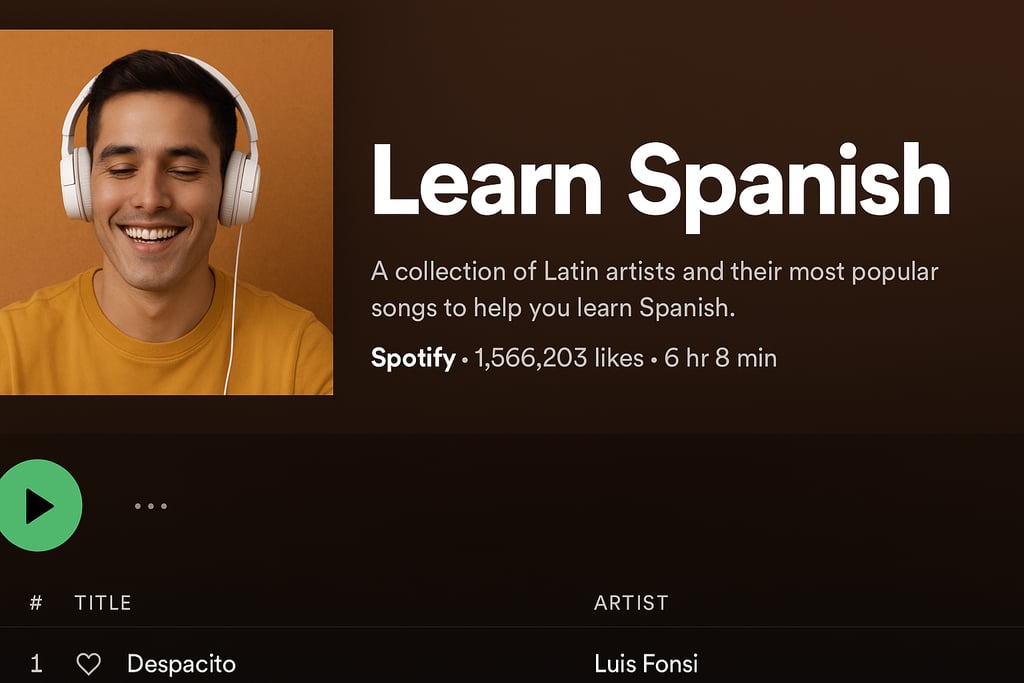
Create a “Learn Spanish” playlist with 10–15 easy songs.
Listen actively — follow the lyrics while reading them.
Write down 5–10 new words or phrases from each song.
Sing along — don’t worry about mistakes!
Review your notes once a week and reuse those words in conversation.
🎯 Recommended for beginners:
“La Bicicleta” – Carlos Vives & Shakira
“Bésame Mucho” – Luis Miguel
“Color Esperanza” – Diego Torres
🎶 For intermediate learners:
“Rayando el Sol” – Maná
“De Música Ligera” – Soda Stereo
“Robarte un Beso” – Carlos Vives & Sebastián Yatra
Final Thoughts: Learn Spanish with Rhythm and Joy 🎵
Learning Spanish through music isn’t just effective — it’s joyful. You’ll pick up pronunciation, expand vocabulary, and connect with Latin culture on a deeper level.
So next time you hit play on your favorite song, remember — you’re not just listening; you’re learning.
Turn up the volume, sing your heart out, and let Spanish become the soundtrack of your journey! 🎤💛
Follow me
Join me to learn Spanish with ease
Contact
support@speakspanishglobal.com
+52 222 188 0049
© 2025. All rights reserved - www.speakspanishglobal.com