
🇲🇽 Understanding Latin American Spanish vs. Spain Spanish 🇪🇸
Spanish isn’t the same everywhere — and that’s what makes it beautiful! Discover the main differences between Latin American and Spain Spanish, from pronunciation and vocabulary to culture and everyday expressions.
Ivette Pérez Téllez
9/28/20253 min read
Introduction
Did you know that more than 20 countries speak Spanish as an official language? With over 500 million speakers worldwide, Spanish is full of regional flavor — from the streets of Madrid to the beaches of Cancún.
But if you’ve ever noticed that Spanish from Spain sounds a bit different from Latin American Spanish, you’re absolutely right.
Let’s explore the main differences so you can understand (and appreciate) both — without confusion.
1. A Shared Language, Many Accents
Just like English has American, British, and Australian accents, Spanish has many varieties.
The good news: they’re all mutually understandable. You can speak with anyone — whether they’re from Mexico, Argentina, or Spain — and still communicate clearly.
What changes is the sound, rhythm, and word choice.
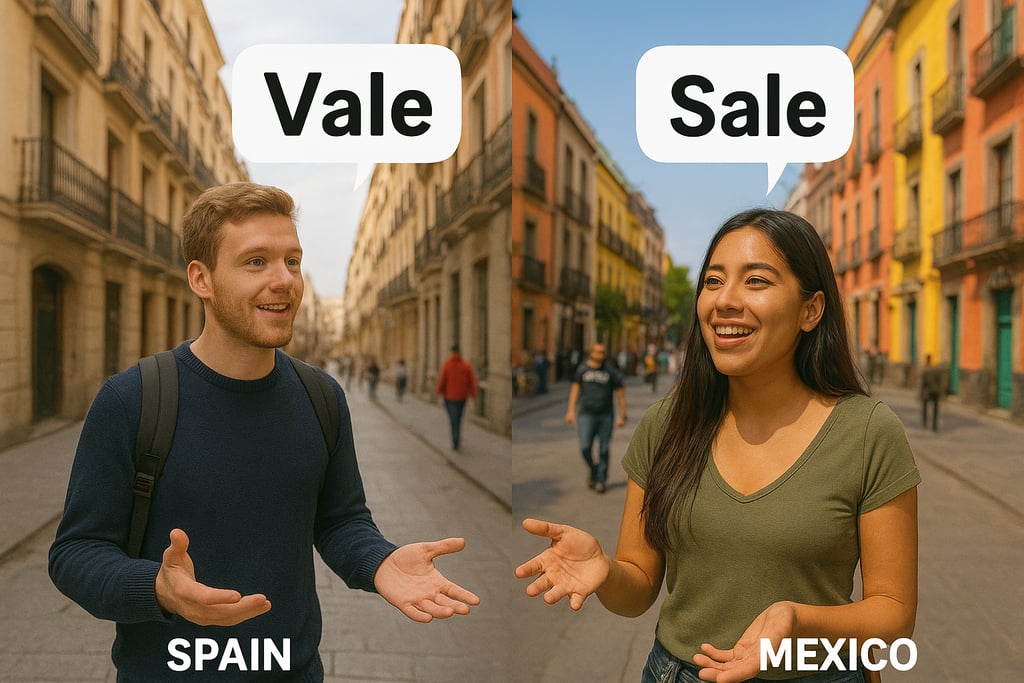
Example:
In Spain: Vale (Okay)
In Mexico: Está bien or Va
Same meaning — different vibe.
2. Pronunciation Differences
The “Z” and “C” Sounds
In Spain (especially central and northern regions), people pronounce “z” and “c” (before e/i) with a “th” sound, like in “think.”
Gracias → “Grathias”
Zapato → “Thapato”
In Latin America, those same letters sound like “s.”
Gracias → “Grasias”
Zapato → “Sapato”
Neither is right or wrong — just different regional accents.
The “Vosotros” Pronoun
In Spain, you’ll often hear vosotros (you all, informal).
Example: ¿Vosotros vais al cine? — Are you all going to the movies?
In Latin America, people use ustedes for both formal and informal plural “you.”
Example: ¿Ustedes van al cine? — Are you all going to the movies?
💡 If you’re learning for travel or global communication, Latin American Spanish tends to be more widely used internationally.
3. Vocabulary Variations
Every region has its own slang and everyday words. Here are a few fun examples:
💡 Tip: If you’re unsure, describe the word instead! For example, “para tomar jugo” (to drink juice) works anywhere.
4. Grammar and Usage
There are only a few grammatical differences — mostly in pronoun and verb use.
Spain: Vosotros habláis español muy bien.
Mexico: Ustedes hablan español muy bien.
(Both mean: “You all speak Spanish very well.”)
In some countries like Argentina or Uruguay, people also use vos instead of tú for “you” (informal).
Vos tenés razón. → You’re right.
Tú tienes razón. → You’re right.
These differences are easy to adapt to once you recognize them.
5. Cultural Expressions and Slang
Regional expressions reflect local identity and humor.
Spain:
¡Tío! — Dude / Guy
¡Qué guay! — How cool!
Vale — Okay
Mexico:
¡Qué padre! — How cool!
¿Neta? — Really?
Órale — Wow / Okay / Let’s go
Argentina:
¡Che! — Hey
¡Qué copado! — Awesome
Learning these adds personality to your Spanish — and helps you connect culturally.
6. Formality and Politeness
In Spain, people tend to be more direct — which can sound strong to Latin American ears. In contrast, Latin American Spanish often uses softer tones and more courtesy phrases.
For example:
Spain: Dame agua. (Give me water.)
Mexico: ¿Me puedes dar agua, por favor? (Could you give me some water, please?)
Both are correct, but cultural style influences the phrasing.
7. Which Spanish Should You Learn?
This is one of the most common questions learners ask.
Here’s the answer:
👉 Learn neutral Spanish — clear pronunciation, common vocabulary, and simple grammar that’s understood everywhere.
Then, as you progress, you can adapt to regional variations based on your interests or travel goals.
If you plan to travel to Latin America or work with international Spanish speakers, starting with Latin American Spanish (especially Mexican Spanish) is often more practical and widely recognized.
Final Thoughts
Spanish is a global language — diverse, rich, and full of character.
Understanding the differences between Spain and Latin American Spanish helps you communicate better and appreciate the beauty of each accent and expression.
Instead of asking “Which one is correct?”, celebrate that you can learn one and understand them all.
After all, the goal isn’t just to speak Spanish — it’s to connect with people, cultures, and stories across the Spanish-speaking world.


Follow me
Join me to learn Spanish with ease
Contact
support@speakspanishglobal.com
+52 222 188 0049
© 2025. All rights reserved - www.speakspanishglobal.com